
What’s a good enough investment return?
I once had a client that routinely got burned by chasing more money. If he'd only realized that he already had enough, he'd be a lot wealthier today.
The irony of chasing more and ending up with less can be seen in many aspects of life. The person who chases more career success only to fail at marriage and parenting. The person who chases more beauty only to end up with too many surgeries and an unfortunate physical appearance.
And just like my former client, many investors chase better returns only to end up with less money.
What does this look like?
We see the stock that's been skyrocketing, so we jump in right before a big correction. We own a stock that’s been falling, so we get out right before a big recovery. It's one of the costliest habits in investing. Morningstar's annual Mind the Gap study found that over the decade through 2024, the average dollar invested in U.S. funds earned about 1.2% less per year than the funds themselves returned.
But, as my client taught me, this can even happen at the advisor level. He sought out my firm's services because he was unhappy about his advisor's portfolio lagging the S&P 500. Then, about a year into the relationship, he threatened to leave because he was unhappy that we were lagging the S&P 500.
He didn't care that the S&P 500 isn't a properly diversified stock portfolio. He didn't care that a good investment manager prioritizes adherence to a smart process over beating an arbitrary index every year. And he didn't care that he was still on track to reach the long-term goals we'd outlined for him.
Unfortunately, his emotions blinded him to the logic required for good long-term outcomes.
At about the two-year mark, this client left my firm. And while I hope that move worked out better than the previous one, I have my doubts. Which stinks, because repeatedly locking in short-term underperformance destroys wealth over time. As he chased bigger numbers, he ended up with smaller ones.
But his mistake points to a better question. It’s the one this whole piece is about: not whether your returns are beating the market, but whether they're beating your plan. And whether you'd even know if they were.
Why should you think like an institution?
Large institutions hire the best investment teams in the world. The reason is often misunderstood.
It's not to get the best returns. Don’t get me wrong, returns matter. But a large institution has one objective: meet short, medium, and long-term cash flow needs. Similarly, smart individual investors simply want to meet short, medium, and long-term spending goals.
Take CalPERS, the pension fund for California's public employees and the biggest of its kind in the country. They must meet the income needs of current retirees, while ensuring they'll be able to meet projected income needs every year in the future. Last year alone that meant paying out $34.6 billion in benefits to some 715,000 retirees, while investing the same $563 billion pool so it's still there for the 25-year-old who won't collect a dime until the 2060s.
Any projected payouts in the next three to five years would be considered short-term. The next five to ten years are medium-term. And beyond that is long-term. Each bucket will be invested differently, based on the time horizon. The shorter the horizon, the less risk. The longer, the more. They call this liability-driven investing, but underneath the jargon it's just matching your money to your timeline.
Now imagine your own situation. When do you want to retire, and what bucket does that goal fall into? Do you want to withdraw any money now? What other future goals do you have, what buckets are they in, and how much will you need to spend?
When you start answering these questions, along with how much money you can add on a regular basis, your investment goals become no different than a large institution's cash flow needs. And once your money is matched to your goals this way, "a good return" has nothing to do with an arbitrary benchmark. It’s simply whether you’re earning what your plan needs.
What if the market hands you more than you need?
You know that great feeling when you get an unexpected time surplus?
Let's say you need to arrive by 7, and your GPS is giving an ETA of 6:30. Are you going to drive calmly and patiently the rest of the way? Or are you going to drive aggressively and try to get there even earlier?
This seems like a ridiculous question. You're in the bonus. Relax and enjoy it!
But most people can't apply this same logic to investing. And it's often because they don't even know they're in the bonus.
One of my wealth management clients came to me with a simple objective: maximize his growth so he could retire in eight years, maintain current spending until his youngest kid leaves the nest, and maintain a comfortable lifestyle for the rest of his life.
This called for an aggressive stock portfolio, combined with a strategy to avoid any forced stock sales in early retirement. In other words, maximize growth potential and minimize "sequence of returns" risk.
Our planning projections assume historical annual returns for each asset class in the portfolio. Recently, stocks have more than doubled their historical average. From 2023 – 2025, the S&P 500 returned roughly 26%, 25%, and 18%. That’s three straight years above 15%; a run that's happened only a handful of times in the last century. And 2026 could extend the streak.
Our clearly defined investment strategy is like a GPS that's telling us we're in the bonus. Renowned investing writer William Bernstein is famous for a line that fits this moment: when you’ve won the game, stop playing. While my client hasn't fully won yet, the market handed him a stretch of the win years ahead of schedule. There’s no need to continue driving aggressively.
By applying some strategic pivots to his plan, we've been able to lower his risk and slightly increase his probability of success. Which means he can spend the next few years feeling excited about retirement instead of nervous about the market.
What if you’re in the bonus right now?
As mentioned, we've been on a historic stock market run. If we zoom out, we've been on a historic run since COVID. And if we zoom out even further, we haven’t had a major bear market in nearly twenty years. Sure, there was a very short one in 2020 and a very shallow one in 2022. But many investors today have never endured the kind of slow, grinding decline that takes years to climb out of.
If you're in the bonus, it's a great time to adjust your sails a bit. You're ahead of schedule, so you don’t need to keep riding the AI boom.
If you don't plan to withdraw cash for at least another 15-20 years, you probably don't need to reduce your stock exposure. An all-stock portfolio might even make sense with that time horizon. But you can still diversify away from AI.
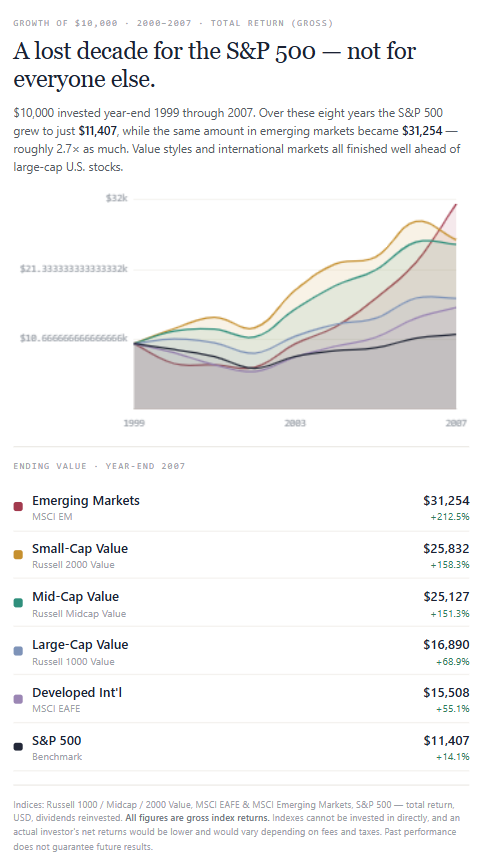
Today, ten stocks make up more than 40% of the S&P 500. But, while expensive large cap growth stocks are driving historic concentration risk, there are plenty of cheaper pockets of the market. Value, mid cap, small cap, and international are all at much lower valuations.
And interestingly, these types of stocks performed very well the last time enthusiasm over a life-changing technology cooled. In the eight years after the 2000 “dot-com” peak, a dollar in the S&P 500 barely budged. But a diversified investor did much better.
If you have earlier withdrawal needs, it could make sense to reduce stock exposure in favor of bonds or alternative assets. Bonds tend to be less volatile than stocks, while alternatives have a low correlation to both, thus reducing the volatility of an overall portfolio.
Either way, the idea is the same. When you know you’ve earned enough, it's ok to sacrifice some short-term gain. Because the only metric that matters is how well you’re progressing toward your goals.
What matters more to you?
Beating the market isn’t the goal. Beating your plan’s projections is. And if you've been invested these past few years, there's a real chance you're already ahead of schedule and simply haven't stopped to notice.
If so, you have a choice. Do you want to bank some of the bonus, because you’ve earned enough to stop depending on historic market returns? Or do you want to keep every chip on the table and keep chasing more?
There's no universally right answer. It’s a question only you can decide on.
Sources for Additional Reading:
Morningstar (2025), Mind the Gap: U.S. Edition
CalPERS, State of the System (FY ended June 30, 2025)
S&P 500 annual total returns, 2023–2025
Bernstein, W. (2012), The Ages of the Investor
S&P 500 bear markets 2020 and 2022 (Yardeni Research)
chart indices from FTSE Russell, MSCI, and S&P Dow Jones Indices (2000–2007 total returns)
S&P 500 top-10 concentration — J.P. Morgan Asset Management and RBC Wealth Management (2026).